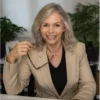

A Compassionate Inquiry® Practitioner, Private Mentor, and multidisciplinary somatic therapist, Lizzie has taught yoga and worked as a Rolfer, Rolf Movement practitioner, and craniosacral therapist for over 20 years. During that time, she also underwent a liver transplant and a colectomy and received a cancer diagnosis, experiences that changed the form of her body and brought new clarity and depth to her inner landscape.
In this excerpt, Lizzie reflects on colitis, disordered eating, and liver transplantation through a question that began in childhood: What is actually mine to control? Hear the full conversation on The Gifts of Trauma Podcast.

Bruna Fossile
LIZZIE: At three years old, I was diagnosed with ulcerative colitis, an autoimmune disease that affected my digestion. Ulcerative colitis is in that family where, for me, there was blood in my stool, there was uncontrolled diarrhea, there was fatigue, there were a lot of other symptoms. My skin would become discoloured. Raynaud’s disease was a part of it. There was no one there to explain to me what was happening. And there was certainly no adult there that was pulling the brake or lending a hand of support. There just was nobody there. And so I carried on.
Over time it became apparent to me that my parents were in a failing marriage. My mother shifted from being an overbearing, overcontrolling, smothering presence to almost deciding she was done with mothering.
When I was about 13, my appearance within my family became a sign of worthiness. That was the one thing I could cotton on to and control, and I basically stopped eating healthfully. I was in a body that was a site of illness. So I always had a kind of bloat, on top of being in a body that is potentially strong but not lean. I felt a level of pressure to be thinner, to be more attractive and fit into clothes in a certain way. That expectation seemed to trump the unconditional quality of love or attunement from my parents. And it became a way of escaping all the other stuff that was going on as a teen who was not feeling very secure, not feeling very stable in my home life. And in a way, it gave me focus. It’s very hard for me now, in retrospect, to pick apart what was the lack of nourishment and what was the flare of my illness. Along with not eating, I was also really obsessively running and exercising.
While it felt like the one thing she could control, restricting her food intake and exercising obsessively added stress to a body already living with an inflammatory digestive disease.
LIZZIE: My sister, I should mention, was also on the sidelines because I cottoned on at around that age that she also was controlling her eating. She was displaying bulimic symptoms. I was aware of that. And we were beginning, more and more, to isolate ourselves away from each other, with our own dysfunctions.
I think the secretive nature is part of the control; it was a part of what I had agency over. I was very aware at the time there was some kind of counterwill in me showing up, having this imprint of an overcontrolling mother on the one hand and me wanting to beat or outsmart her. There was a lot of mistrust that was not born in the eating disorder. But over the years, when I think back, there was some kind of push-pull in the relationship. It was not necessary and certainly was not helpful to anyone, but it was there nonetheless.
Years later, Lizzie encountered the first real crack in that pattern.
LIZZIE: I was four or five years into regularly going to yoga classes. There’s a beautiful moment in a young person’s life when you’re setting off and there are possibilities. I was at the other end of that; I was a bit jaded already. During this time, a realization came to light when I was in a class: my pelvic floor was clenched like a fist. It really struck me, that realization, so much so that when I got home that evening and was cooking myself some dinner, I thought to myself, I’m still doing it. Then I went to read a book, and I noticed I’m still doing it. I realized, because of yoga, I could actually not do it. There was another possibility there.
That discovery opened Lizzie to the realization that some of what she had seen as facts about her body were, in truth, choices. But nothing tested that shift more than what came next. At thirty-one, Lizzie was diagnosed with a rare secondary illness and told she had roughly ten years before end-stage liver failure. What followed was a waiting game she couldn’t control.
LIZZIE: There are a million things that can take twists and turns between getting a good enough organ and having a good enough surgeon. For example, my hepatic duct is in a totally different place than the donor organ’s, and so the surgery ended up being very long and complicated. They called in several surgeons, and it was a 12-hour procedure. I was in the hospital for 59 days afterward, because just about every little thing that could go wrong did. And yet, it was a success. That’s where the story begins as far as I’m concerned, because there’s making it through this big surgical event, and then there’s how do I pick up life now?
The integration process allowed me to speak to this new organ, to hold it, to be curious about it and grateful for it. Over time some of that has stayed. I’m very aware of what most places of my body feel like; what does the kidney space feel like? Or the liver? Not a day goes by that I’m not aware that I have a transplanted organ, and it’s really mine. That didn’t take years, just several months of this work.
Thirteen years on, Lizzie carries that lesson. What she offers to the clients who come to her as a Rolfer and a Compassionate Inquiry® Practitioner isn’t certainty. It’s something closer to what she had to learn to give herself.
LIZZIE: One thing that has been one of the most important aspects of coming to terms with pain, with healing, is finding out what I can manage. What is the one thing that is possible for me right now, today? For me, it’s about finding that one thing that I can trust or believe in and holding it delicately or gently so that it’s not fixed. There’s something about life being semi-fixed. Nothing is permanent. Everything is shiftable.
The Gifts of Trauma is a weekly podcast that features personal stories of trauma, transformation, healing, and the gifts revealed on the path to authenticity. Listen to the full conversation, and if it resonates, please subscribe, rate, review, and share.
Editor’s Note: This post comprises edited excerpts from The Gifts of Trauma podcast transcript. Selected passages have been carefully woven together to create a cohesive narrative that speaks in the guest’s voice and faithfully represents her perspective. – Rosemary Davies-Janes