

I like a plan.
I like knowing what time we are leaving, how long it should take, what happens next, and whether there is enough time to get a coffee before boarding. None of this seems particularly unreasonable to me.
Reality, unfortunately, does not always share my commitment to the itinerary.
Flights are delayed. Roads close. Weather changes. Plans get cancelled. Someone says, “Actually, could we do tomorrow instead?” when I have already mentally arranged the rest of the day around what was supposed to happen.
Usually, the practical adjustment is fairly simple.
It is the internal adjustment that can take a little longer.
Recently, I have been thinking about this through the lens of non-attachment. Not as an invitation to stop making plans, lower expectations, or become indifferent to what happens, but as a question about what takes place inside us when reality diverges from the version we had already created.
Because sometimes the difficult part is not that the plan changed.
It is that I had become attached to it not changing.
When a Preference Becomes a Demand
There is nothing inherently wrong with wanting things to go a certain way.
We can prefer the direct flight to the five-hour delay. We can hope the weather holds. We can want the dinner reservation to still exist when we arrive. We can make thoughtful plans and do what we reasonably can to support the outcome we want.
The difficulty may begin when a preference quietly becomes a demand.
This should not be happening.
They should not have changed the plan.
I should know what is happening next.
It was not supposed to go like this.
At that point, I am no longer simply responding to what has happened. I am also arguing with the fact that it happened at all.
I have done this in airports more than once.
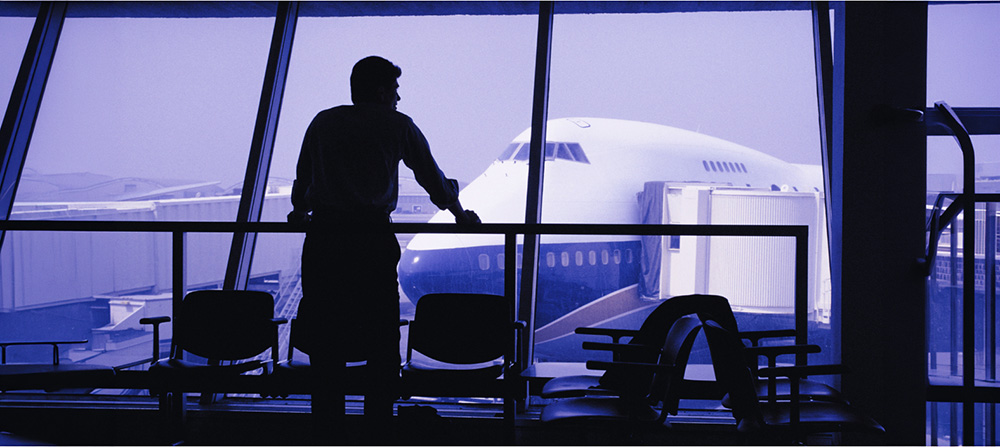
There is something almost impressive about the mind’s ability to treat a departure board as the opening statement in a personal dispute. The word “DELAYED” appears, and within moments there is an entire internal case being assembled about why this is inconvenient, badly timed, and contrary to the perfectly reasonable arrangement I had made with the universe.
The plane, of course, remains unmoved by my objections.
Eventually, there is only the situation itself.
And my relationship with it.
The Plan in My Head
Travel makes this particularly visible because so much of it involves uncertainty disguised as certainty.
We book the flight.
We choose the hotel.
We make the reservation.
We look at photographs.
We check the weather.
Without realizing it, we may begin travelling long before we leave. We create an imagined version of the experience and start relating to that version as though it has already happened.
Then the real experience arrives.
Sometimes it is better than we imagined.
Sometimes it is harder.
Sometimes the place we expected to love leaves us strangely unmoved, while somewhere we barely thought about becomes the part we remember.
The problem is not imagination. Anticipation can be joyful.
But I wonder how often we become so attached to the experience we expected that we struggle to meet the one we are actually having.
A rainy afternoon is no longer simply a rainy afternoon. It is interfering with the holiday we were supposed to have.
A change of plans becomes something to recover from rather than something to respond to.
We can spend so much time comparing reality with the version in our heads that we barely notice where we are.
When the Change Is Bigger
Moving countries offers a larger version of the same experience.
Before a move, there is inevitably an imagined future.
We picture what daily life might feel like. We anticipate what we will miss and what we will not. We imagine how quickly we will settle, which parts will feel familiar, and what the new chapter will become.
Then we arrive and begin living a life rather than imagining one.
The things we expected to be difficult may turn out to be surprisingly manageable. Things we barely considered may suddenly matter. What felt exciting from a distance can feel unfamiliar up close. What seemed ordinary can become precious once it is no longer part of everyday life.
This is not necessarily disappointment.
It is simply the difference between imagining a life and inhabiting one.
And perhaps this is where attachment to our expectations becomes easier to see.
We do not only make plans for our days. We make plans for who we will be once we arrive somewhere.
Once I move.
Once this changes.
Once I get through this period.
Once life looks the way I expect it to.
There is often a future version of ourselves waiting somewhere inside the plan.
Reality may have something less tidy in mind.
What Is Control Trying to Give Us?
It would be easy to make this another reason to criticize ourselves.
Why can I not just go with the flow?
Why do I need to know?
Why am I so bothered when plans change?
But through the lens of Compassionate Inquiry®, a more useful question may be: what does knowing seem to give me?
Perhaps predictability feels safe.
Perhaps planning helps us feel prepared.
Perhaps knowing what happens next creates a sense of steadiness when uncertainty feels uncomfortable.
Perhaps control is not simply control for its own sake. It may be an attempt to avoid the vulnerability of not knowing.
Seen that way, attachment to an outcome begins to make more sense.
The mind is trying to take care of us.
If I can know what happens next, perhaps I can prepare for it.
If I can make everything go according to plan, perhaps I will not have to feel disappointed.
If I can anticipate every possibility, perhaps nothing will catch me off guard.
There is compassion available in recognizing this.
Not because every attempt at control is helpful, but because there may be something understandable beneath it.
Non-Attachment Is Not Not Caring
Non-attachment can easily sound like distance.
Do not expect too much.
Do not care too much.
Do not become invested.
But I do not think that is what it asks of us.
In the Compassionate Inquiry® lens, non-attachment invites us to remain present without clinging to a particular outcome, interpretation, or expectation.
That distinction matters.
I can want the flight to leave on time and accept that it has been delayed.
I can make a plan and respond when the plan changes.
I can hope that a new chapter unfolds in a certain way while remaining curious about the life that actually emerges.
I can care deeply about what happens without believing that I get to decide what must happen.
And I can stay present when what happens is different from what I hoped for.
Perhaps that is where non-attachment begins to feel less abstract.
It does not ask me to stop participating in my life.
It asks me to notice when participation has become negotiation with something that is already true.
Coming Back to What Is Here
I am still going to make plans.
I will still check flight times, look at the weather forecast, think ahead, make reservations, and probably feel irritated when something changes at the last minute.
Non-attachment does not require me to become a person who greets every inconvenience with serene acceptance.
That person sounds exhausting in a completely different way.
Perhaps the practice is smaller.
To notice when disappointment becomes resistance.
To notice when a preference has hardened into “this must happen.”
To notice when I have become more engaged with the day I expected than the day I am actually living.
And then, if I can, to come back.
What is happening now?
What am I feeling now?
What am I afraid this change means?
What becomes possible if I stop arguing with the fact that it has already happened?
These questions do not make uncertainty disappear.
They do not make the plane leave sooner, restore the cancelled plan, or guarantee that the next chapter will unfold as we hope.
But they may bring us back into relationship with the moment.
Maybe non-attachment is not about wanting less from life.
Maybe it is about holding what we want a little more lightly, so that when life inevitably becomes something other than what we planned, we are still here to meet it.
Reality may continue to ignore my itinerary.
I am beginning to suspect the negotiation was always rather one-sided anyway.