
Season 04 – Episode 105: From Colitis to Liver Transplant: Balancing on Shifting Ground, with Lizzie Reumont
By The Gifts of Trauma /
Listen this episode here:
soonor here
Diagnosed with an autoimmune disease at three, Lizzie grew up not feeling safe within her own body. A volatile home meant she didn’t feel safe outside it either. This candid conversation traces a decades long journey from a childhood marked by chronic illness and family instability, through disordered eating and compulsive exercise to a liver transplant at 31, the long work of making a stranger’s organ her own, and what it takes to keep finding, again and again, a small enough foothold to trust she can balance.
Lizzie shares:
- How a psyche and body under siege shaped a pattern of control through eating and exercise
- What it took to wait for, survive, and recover from transplant surgery
- What her transplanted 80-year-old liver is teaching her about time, aging and her own body
- What drew her, a 20-year veteran of structural bodywork, to Compassionate Inquiry®
Join us to hear how three decades in the treatment room, five decades of living with chronic illness, and one organ transplant brought Lizzie to a practice built on trust, patience and staying gently curious about what her body is still holding.
Episode transcript
00:00:01 Rosemary
If you’ve completed or are currently enrolled in Compassionate Inquiry training, you’re invited to attend the third International CI Conference in Vancouver, Canada from October 30 to November 1. Dr. Gabor Mate is returning as our keynote speaker and masterclass presenter. Enjoy engaging workshops and inspiring demonstrations with Sat Dharam Kaur, CI facilitators and practitioners. Whether you join us in person for three days of shared inquiry with CI cohort partners and colleagues from around the world, or attend virtually to focus on the teachings, tap the link in the show notes to learn more and secure your place. And yes, there will be dancing.
00:00:49 Lizzie
People would come in experiencing one aspect of their physicality or their body, leaving in a different place, structurally in a different place, maybe even emotionally in a different place, perhaps even more regulated. However, the next time I saw them, some pattern would re emerge that I couldn’t touch. I couldn’t access this because I didn’t have the language to know even how to begin to engage in a conversation that would not be an analytical one. And so for me, CI started to represent this glue between the structural work and Rolfing structural integration. That’s one aspect of what it means to be in a deep intimate relationship in an embodied way with a changing physical system. And another is to bring in this other aspects of what it means to be human, to be able to not only touch the body and all of the emotions, all of the narratives, all of the experiences a body may hold, but also be able to ask it questions where there is a possibility for release. And so for me, that’s what drew me to CI.
00:02:09 Rosemary
This is the Gifts of Trauma Podcast. Stories of transformation and healing through Compassionate Inquiry.
00:02:27 Rosemary
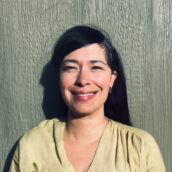
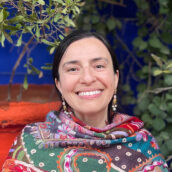
Welcome to the Gifts of Trauma podcast by Compassionate Inquiry. I’m Rosemary Davies-Janes and joining me today is Lizzie Reumont. Lizzie is a somatic therapist, a Rolfer, a Rolf Movement practitioner, a cranial sacral therapist, a yoga teacher, a Compassionate Inquiry practitioner and mentor, and she’s based in Surrey in the uk. Welcome Lizzie. It’s great to have you here.
00:02:53 Lizzie
Hello there, Rosemary. Thank you so much for having me. What a pleasure to be here with you.
00:02:58 Rosemary
The pleasure is totally mine. Now your full bio is in the show notes, so I’ll invite you to share whatever you’d like here.
00:03:09 Lizzie
Well, the first is that this long list of things that you read off is sort of a part two of my working life and I realize in hearing it back that I probably need to weed out a little bit of the… all of the different labels and just say that really I’m a human being that has gone through a vast landscape that I would say has had its challenges. And along the way, I have learned quite a bit about myself, and very gratefully, I’m a compassionate and curious person. And so I’ve ended up in a place now where I feel I have something to share and possibly something that might benefit other people. And that’s been my second chapter in life, was all about wanting to do that, wanting to make meaning out of it. Yeah.
00:04:02 Rosemary
Wonderful. Thank you. I wonder if you have an intention you would like to share.
00:04:08 Lizzie
for our time together? I would like to show up authentically. First and foremost, I would like to slow down and be thoughtful about the questions that you might ask me and if possible, just be able to share a little bit of what has been helpful for me along the way, for other people that might be tuning in, who have had a flavor of what my life experience is, and also realizing that at the end of the day, my sense is that pain and suffering is pain and suffering. And we can put all kinds of different labels on it, but there’s a kind of a shared humanity. And we’re all just trying to work out what resonates for each and every one of us. And being in space and time also seems to be important, that we’re not always ready to hear exactly that thing from the person we think we are. So it may be that there’s one little nugget that someone’s just ready enough to hear that is valuable.
00:05:06 Rosemary
Having looked into your work and your background, I have no doubt that there will be many nuggets that you hand out over the course of this conversation. And my intention is really to explore what becomes possible in the treatment room when the practitioner has lived inside the very landscape they’re asking their clients to enter. And also what that particular kind of knowing offers to anyone whose body has been the site of illness, medical trauma, even a lifetime of not feeling safe within themselves. So, different words, but I feel our intentions are very aligned. Thank you.
Looking at everything that you’re drawn to personally and professionally, I am struck by how many different ways you engage with the world. And there’s a thread running through all of it that makes complete sense. I’m curious whether you’ve always experienced yourself that way, as someone with many deep interests, and that those interests somehow belong together, or whether that coherence only became visible in retrospect.
00:06:18 Lizzie
That’s such a beautiful and important question. For myself, I think that there was a thread that was there, as a young age, I recall myself being an open hearted and curious and very creative person. However, it seemed to be disrupted for me at some point. I mean, I’ll name an age of sort of 12, that’s been an age I’ve gone back to again and again. And at that point I was not a very curious and engaged person in a lot of ways. And I became more singular in focus, in a way that may have been a survival strategy, it may have been an escape. There’s many different labels we could put on it. However, my world got very small for a number of years and that small container, the container of the smallness seemed to shift over time. And it wasn’t really until that container was going to break altogether or that was the message I was getting from the medical world, that I had to wake up and start to find another way to inhabit my body and to inhabit the world. But it took time. It really did take time.
00:07:32 Rosemary
Would you be willing to share what happened that put you in this place when you were around 12? Did… was there an event? Did something happen? Did something change in your life?
00:07:43 Lizzie
Yeah, I would say that it wasn’t an epic kind of seismic rocket that fell into my world in one day. However, I think that over time it became apparent to me that my parents were in a failing marriage. My mother shifted from being sort of an overbearing, over controlling, smothering presence to almost deciding she was done with mothering. And I’m not blaming anybody because I can see as a mother how that could happen with all the different hormonal changes that we go through in a landscape of a marriage that is definitively over. I was very much in a situation where my appearance within, my, within at least aspects of my family were really a sign of worthiness. And that was the one thing for me that I could cotton onto and control. So when I was about 13, I went down the route of basically stopping to eat healthfully. I was in a body, a site of illness. I, you know, at three years old, I was diagnosed with an autoimmune disease that affected my digestion. So I always had a kind of bloat to me, on top of being what is a body that is a potentially strong body, but not a lean one. And I felt a level of pressure to be thinner, to be more attractive and fit into clothes in a certain way. And that expectation seemed to trump the unconditional quality of love or attunement from parents. And that became a way of escaping all the other stuff that was going on as a teen who was really not feeling very secure, not feeling very stable in my home life. And it gave me focus in a way. There were some other things going on as well, but for me, those were really the main themes.
00:09:47 Rosemary
Yeah. And what happens with your history, the digestive issue? You said it was chronic. So what happens when someone with that going on in their body decides to take charge and distract themselves by changing what they eat?
00:10:04 Lizzie
Yeah. Well, for me, my sister, I should mention, was also on the sidelines because I cottoned on at around that age that she also was controlling her eating. She was displaying bulimic symptoms. I was aware of that. And we were beginning more and more to isolate away from each other with our own sort of dysfunction, you could say. It’s very hard for me now, in retrospect, to pick apart what was the sort of lack of nourishment I was getting, and what was the flare of my illness. And I think, to a certain extent, not having really kept a journal during that time, some of it is a blur. However, I was… along with not eating, I was also really obsessively running and exercising. And I did have a flare. At two or three different points in my adolescence, I had a flare. Doctors did not know that I had, on top of that, some kind of disordered eating or coping mechanism of being very controlled in my eating. And I would come on and off steroids, which almost made things worse because I was all too aware of the side effects. I was very worried about the hair growth, and I was very worried about gaining weight. And in a way, it pushed me even more into the wanting to control something. And that something that I seemed to be able to control at the time was my weight. And that became the real kind of thing that was more important than how I was doing in school, than whether I was achieving in sports, whether I was supporting my parents through their challenges. That was really what I had going for me at that time. Yeah, yeah.
00:11:54 Rosemary
And the term you use, the flare, is that a flare up of your autoimmune disease?
00:11:59 Lizzie
Yeah, yeah. Ulcerative colitis is in that family where, for me, there was blood in my stool, there was uncontrolled diarrhea, there was fatigue, there were a lot of other symptoms. My skin would become discolored. Raynaud’s syndrome was a part of it. So there were a lot of different medical kind of couplings going on in my system, but there was no one there to explain to me what was happening. And there was certainly no adult there that was pulling the brake or lending a hand of support. There just was nobody there. And so I carried on.
00:12:39 Rosemary
Yeah. And it probably doesn’t help that eating disorders tend to make people very secretive. It’s not like you would have told anybody that this is going on because then it could have been taken away from you.
00:12:50 Lizzie
Yeah. I would even change the wording slightly of that, that the secretiveness is a part of what is appealing about it. So instead of it being the eating disorder that’s making the person secretive. I think that secretive nature of things is a part of the control and it was a part of what I had agency over. And I was very aware at the time there was some kind of counter will in me showing up, having this imprint of an over controlling mother on the one hand and me wanting to win, me wanting to beat her or outsmart her or… There was a lot of mistrust that probably was not new. It was not born in the eating disorder. But over the years, when I think back, there was some kind of push pull in a relationship that was not necessary and certainly was not helpful to anyone, but it was there nonetheless. Yeah.
00:13:47 Rosemary
You also wrote that as a child your home did not feel safe, but then again, neither did being in your body. And I wonder if you’d say a little bit more of that because it seems very related to what you just shared.
00:14:00 Lizzie
Yeah. Going back, everything is now a memory. It’s not to discount that I didn’t grow up in a circumstance that was as horrible as it could be. And at the same time I had an older sister that was really not pleased to have a younger sister. And there are lots of kind of anecdotes that would reinforce that. I had a father that was an adult child of an alcoholic who was very volatile without being outwardly physically abusive. There was quite a bit of control and kind of emotional aspects that are borderline abuse. What I would call not a loving relationship between mother and father a lot of the time. So there was a lot of loud fighting, there were nights that we were taken to hotels. Just the mere fact that my family, we never ate a meal together, because my dad was a doctor by profession and that for him was his whole world. So he escaped into needing to be the best at what he was doing and that took over his identity to a certain extent. There was resentment by my mother. So this kind of continued for a number of years through an arc of moving away from where my other family was, where my parents grew up, and then moving back. There was no real place that I could be rested in the environment, and certainly my body was giving me signs which I did not learn until much, much later were signs that in fact my nervous system was in a kind of a trauma vortex a lot of the time, just wanting to find a place of not safety even, but vigilance, finding a way to almost expend that energy that was somatic fight or flight energy. Yeah.
00:15:59 Rosemary
You spoke about distracting yourself with the whole control issue around eating. You also wrote that in your teenage years, you spent a lot of time doing everything possible trying to disconnect from your body. And obviously controlling your food was one thing. And I’m just wondering, were there other things? What did that look like? And at the end of the day, what finally made disconnection no longer a possibility?
00:16:25 Lizzie
I mentioned exercise. And for a lot of my teenage years, I went on to run marathons and was running 10 miles to a gym to lift weights. And 10 miles back, there were like extreme strokes of really wanting to find that place of calm in my world at that time. I suppose I was 18, 19 years old. That was the way that I found calm. I explored some recreational marijuana use. I explored psilocybin recreationally. And that’s as far as the, let’s say, escapist experimental young adult went into sort of drugs and alcohol, mainly because I could feel the same possibilities in that extreme behavior, and pulled myself back, knowing that was not going to be a viable solution for me. I did eventually find yoga. That was… while initially the yoga was fast and furious, Ashtanga type of very wanting to get the anger out. That idea that I could get the anger out of me, really I associate to those Ashtanga years where I would just go and sweat and not be so interested about the placement of my body in time or what was happening. That came later. However, it did dawn on me about maybe a year and a half or two years into my yoga practice. And I would say that when I started to get into pranayama breath work combined with yoga, that started to shift more. But it really wasn’t until I had another big health episode that I didn’t have anywhere else to go. I really needed to start to do the inner work more earnestly. At that point, I had moved country. 28 years old. I went and accepted a job as a creative director in the Netherlands. And so I effectively left the US and moved to Europe. I found myself in a country that I actually lived for seven years there. My work actually took me away from the Netherlands and I moved to Austria for about 18 months. During that time, I had a gastroenterologist in the Netherlands who was taking routine blood tests. And I took one before I left. And then I was gone for 18 months. And I happened to come back into the country, going to an appointment with the said gastroenterologist, who was furious when I showed up at his door and said, where have you been? You have abnormal blood work. I’ve been trying to get in touch with you for 18 months. And, you know, I was sort of not tuned in to the risks that might present themselves, anything like that. So I ended up going back to the US where my family are very much interwoven into Johns Hopkins Hospital. So I went there, I had some tests, and I was diagnosed with a secondary illness that is very rare. It’s coupled with ulcerative colitis, and that’s called PSE, primary sclerosing cholangitis, which is a scarring disease that takes over the biliary system and then goes on to take over the liver. So essentially on that trip I was told, look, you’ve got 10 years before you’re going to be in end stage liver failure. And that really woke me up. One, because at that point I really had no idea where the liver even was in my body. I almost blush saying that, given the work that I’ve been doing for the past 25 years. But the other thing was, what I heard is, I’m going to die. I didn’t hear the idea of receiving a transplant and all of the myriad steps that might entail to get there was just too big for me to possibly imagine. And I remember spending one night curled up in a fetal position on my mother’s carpet, just not knowing how to put one foot in front of the other. There was a real death of something destructive in me that I never would have named that, I never would have put a finger on. But looking back, I was just sabotaging myself left and right, almost not knowing that there was another way that would be possible to be alive. Yeah, yeah.
00:20:49 Rosemary
Yeah, yeah, what shocking news to get because you would have been still quite young when you got that.
00:20:54 Lizzie
I was 31 years old.
00:20:56 Rosemary
It’s not what you expect at that age at all. You also described a moment in a meditation class in Amsterdam where an internal voice told you, ‘Nobody is telling you what to do. You have a choice and you are choosing to constrict your muscles right now.’ And that also sounds like a threshold moment, another tipping point. Can you share a bit about this, about what happened next?
00:21:22 Lizzie
By that point, I was about maybe four or five years into regularly going to yoga classes. And that was after my diagnosis, the PSC diagnosis/ I went back to Amsterdam. I took some time off because I simply went from one day to the other, really not being able to focus, not believing that the work that I was doing was important in any way. There’s a beautiful moment in a young person’s life when you’re setting off and there are possibilities and you realize that there is the potential to create and be quirky and come up with new ideas. And I was at the other end of that. I was a bit jaded already. I came back as a creative director working for big name brands and not having one penny to rub to the other. No ideas, no interest in giving direction to graphic designers, no interest in putting on a facade for a business owner. I was just done. I was really and truly done. And it’s during this time, probably this realization came to light when I was in a class and realized that my pelvic floor was just clenched like a fist. It really struck me that, that realization. So much so that when I got home that evening, I was cooking myself some dinner and I thought to myself, I’m still doing it. And then I went down to read a book and I realized, I’m still doing it. And I realized because of yoga, I could actually not do it. There was another possibility there. And that was the opening to lots of other more subtle understandings of how much tension I had been carrying with me, especially the pelvic floor. Having an autoimmune disease process in one’s body where there’s no security of needing the toilet or not. My sense is that there was a lot going on in that. The kind of Muladhara chakra. If you’re speaking about the chakra system, which is also about security and survival. There were many other locations in my system that were more closed than open. And I started to get more in touch with that.
00:23:35 Rosemary
You write beautifully about the intersection of fear and potential. And I noticed that you also quoted Marianne Williamson, which is actually one of my favorite quotes, where she says, “Our deepest fear is not that we’re inadequate. Our deepest fear is that we’re powerful beyond measure and it’s our light, not our darkness, that most frightens us.” It sounds like from what you’ve shared, that all of that started to become quite noticeable to you where it hadn’t been before… the veil was lifting. I wonder if you’d like to reflect on that.
00:24:09 Lizzie
My sense is that is the case. I think these things are threads, like a tapestry in life. I would be very much lying if I would say that fear never comes up as a potential limitation in my life. And now I’m just going for it left and right. Because that fear is there for a reason and it is one of the many myriad of emotions that exists within me. However, it’s not the driving force behind me at this stage. And when I look back to that time, I wasn’t even aware that fear was lurking behind every constricted muscle, behind every kind of shutting down. During that time I also remember just being very insular in my life. I was not going out and looking for new relationships or new possibilities. I was terrified of dying and my body. Yet what’s my body constricting? Is that gonna save me? Of course it’s not gonna save me. But I needed to get in touch with that and start to get in touch with the other side of that, which is expanding out. And in Rolfing, we talk about what’s the end movement. There’s a Rolfing word called palatinicity, which is a totally made up word. It’s really there to describe what’s the potential in any direction for our body to expand its awareness. For me, starting to understand some of the dynamics at play in Yogasana was an important aspect of orienting to where I was. This whole kind of proprioceptive notion that here I am in space and time, there’s no immediate threat other than the tension in my body, actually, so what am I going to choose to do about that? And that became something that I could explore little by little. And even though I may not have even been aware that those were the beginnings of what would become the exploration of my lifetime, of what’s the inner landscape like? And, you know, if I can be with that, how much richer can my outer landscape be? It was the beginning of becoming aware there is something going on inside of me and it’s limiting me more than any illness’ label. And that was big for me.
00:26:26 Rosemary
Yeah, that would be huge. I get that. Thank you. You did end up having a liver transplant. When you mentioned your first response to that suggestion, there was… It sounded like your body was saying no or your mind was saying no. And then it eventually happened. And I’m curious, was there no other option?
00:26:47 Lizzie
As I mentioned before, the doctors when I was 31, gave me a prognosis. You know, it’s important to say that a prognosis is just a prognosis. No doctor is a miracle worker. They are human beings who are doing the very best they can every day to assess and treat based on their knowledge, and based on how much the patient is willing to work with them, and have also, a voice. And that’s not always possible, however, my sense is that’s a whole nother almost conversation about learning how to be in relationship with someone who you really rely on, you know, at some point may save your life. And so I was given a prognosis that I would, in 10 years, I would likely be in end stage liver failure. And that was kind of it. I went back to the Netherlands. I made some very big adjustments in my life. One was leaving the Netherlands after some time and moving to Kosovo. One of the reasons I had moved to the Netherlands in the first place was for love. So I had met this man in the United States who was actually Belgian. We broke up for a period of time and then we got back together and he was working for the UN in Kosovo. I always felt safe with this person. Being in an extreme lack of safety really underlined that there’s something unconditional here that I’ve never experienced before in my life. So I made the choice to go to Kosovo to be with this person and to start over. That it was a place like the Wild West, where if you show up with a set of tools, there’s a space for you to do your thing. And there really was. And so for a number of years, I was in the Project Lizzie phase of my life where I was doing everything I possibly could at the 11th hour to become healthy. I became a yoga teacher. I did a Thai massage training. I then went on to do a craniosacral training. I was exploring this and exploring that and realizing that I had the capacity to hold a space for people, to teach yoga. I never taught anything in my life. And guess what? There’s people who need yoga and who need a set of hands that can palpate and feel and connect. And so suddenly there’s a 180 where I left this whole creative direction job behind and was blossoming into this other person who was sprouting my own beans and doing all of these different things that were becoming my own. The yoga practice. No teachers in Kosovo. You know, suddenly I’m my own teacher. I’m my own nutritionist. I’m my own therapist in lots of ways. And so that kind of became the years of learning and of supporting myself to some extent. You know, I was doing the best I could. And then arriving back in London, where we moved, getting married and becoming pregnant with my son, which was the real catalyst, the grand finale fireworks of my old liver, it couldn’t cope with that. And so the pregnancy was extremely challenging. There were lots of very big medical trauma arcs throughout that period. And nonetheless, I gave birth to a wonderful boy. I was two months early, so he was seven months when I gave birth. And things never were the same in my body. Yet no doctor ever once told me, this might make things more challenging for you. You may need to keep an eye on X, Y and Z. And it became a car trip on December 28 from London to Norfolk for a friendly New Year’s holiday when the pain in my body was so excruciating that there was an ambulance waiting for us at the Airbnb holiday place. And for five days I was in a random hospital in Norfolk and there was no diagnosis. There was a suspicion that I might have pancreatitis at the time. Went back to London, saw my hepatologist who said, hey, pancreatitis could happen to anyone once, and left it at that. And eventually there was a new doctor who had to come and give me the news that this was it. I really needed a liver transplant.
00:31:15 Rosemary
I’m curious. I was privileged years ago to interview Dr. Paul Pearsall, who wrote the Heart’s Code about transplants. And I have never had the opportunity to speak one on one, as we are here, with someone who is a transplant recipient. And I’m wondering, what was that experience like for you?
00:31:35 Lizzie
It was big. It was big for quite a few reasons. So the thing about transplants is, you are not necessarily going in for the definitive transplant when you get the call. So for me, I got a call at about four months that there was a liver and I went in and got ready to go. And they… It’s a very big process. You have to be very clean, they tag your arms and your legs. And I was there for about 12 hours waiting only to hear, ‘Oh, it’s not a go.’ There was something wrong with that organization. So between the person dying and the organ being harvested, lots of things can go wrong in that process. It wasn’t until the second time I got the call, which was very unusual. I’m not someone who is a big believer of, like karma or it was in the stars. I am someone who will put something out and hope and pray in my own way to my own version of what is a universal godhead. I did that during this time. I happened to be in my Rolfing training when I went into liver failure and I really didn’t want to miss that third phase of the training. We had a three month break between phase two and phase three and I just was desperate for me to get the call during that time. And it actually happened that I got the call during that break period. I was very blessed that my mother happened to be visiting my family when I got the call, and very blessed that the night that I got the call, my friend’s husband happened to be the surgeon on duty. And as much as they tried to find someone else, because it’s not ethically sound, they couldn’t. And this person I knew and I trusted and I went in so excited, there was not even a sliver of doubt that things may not work out. So that part was really thrilling in a way, that this is happening, that I’m going to live and I’m going to come out on the other end of this. And then things obviously went well enough. Here I am. However, there are a million things that can take twists and turns between getting a good enough organ and having a good enough surgeon in place. For example, my plumbing, where my hepatic duct is, was in a totally different place than the donor organ. And the surgery ended up being very, very long and complicated. They called in several surgeons. It was a 12 hour procedure by the end of it. And then I was in the hospital for 59 days afterward, because just about every little thing that could go wrong afterward did. And yet, you know, it still was a success. That’s where the story begins as far as I’m concerned, because there’s making it through this big surgical event and then there’s how do I pick up life now? And what does life mean now? And then you’re out and it’s like everybody assumes that you’re just all healed and life goes back to the way it was, and that’s just not the way it was for me.
00:34:53 Rosemary
And you had a part of someone else with you as well.
00:34:56 Lizzie
I had a 67 year-old’s liver and I had a three and a half year old son who had not really had his mother around for the better part of a year. And so those were the two big challenges. How do I be okay with inheriting a part of somebody else’s body? How do I go about making that my own? And how do I rectify? How do I connect? How do I reconnect with my son? What do I need to do so that he feels safe now after this big episode? So there was a lot of work to be done there.
00:35:33 Rosemary
Yeah. And I understand that you didn’t necessarily follow all the doctor’s orders on your recovery because there was so much to do. And I’m wondering where your Rolfing training landed in this. Did you go back? Did you resume phase three?
00:35:49 Lizzie
Oh, yes. I will forever be grateful for my teacher, my mentor and my friend who believed in me and who saw something that he said yes to. That as long as I wanted to be there, I could be there. In retrospect, I would have done things a lot differently. I now have time and the wisdom that comes along with time and this kind of inner work that we do to understand that a lot of my old patterns were really in full force when I decided after one month of being at home to resume teaching yoga, to resume being in this pretty full on training, and still without a healed wound, which really I had the bandages being cleaned for months and was out there rolling my sleeves up and moving forward with my life. But I really wasn’t in some ways moving forward with my life. I think fear was really alive and well in me, and was a very big driver for me to resume, rather than that drive coming from a place of I’m so grateful to be alive and I feel okay to be doing this work. So. Yeah.
00:36:58 Rosemary
Yeah. And that, that sort of touches back to what you went through as a teenager. It’s like, I’ll focus on this so I don’t have to think about that.
Lizzie: Absolutely, yeah.
Rosemary: You wrote about imagining the person whose organ saved your life because you’re carrying a part of that person with you in some way. I’m wondering how the introduction of whatever part of that person you inherited with their organ has landed and been integrated into you, Lizzie, who you are as a person.
00:37:29 Lizzie
Yeah. I don’t know if you’re familiar with continuum work. It is another kind of somatic work that is more about being in the fluid self. There is sounding that happens, working with sound vibration. There is more of containing a fluid body. You know, Rolfing can sometimes be like an intervention type of work in the structure. And this is more of integration work that was with someone who I trusted. And that process allowed me to speak to this new organ, allowed me to hold it and be curious and to be grateful for it. And I think over time some of that has stayed. You know, I’m very aware of what most places of my body, at this stage, I have a deep awareness of what that feels like. You know, what does the kidney space feel like or the liver? And there’s not a day that goes by that I’m not aware that I have a transplanted organ. However, that organ is really mine, at this stage. That didn’t take years, you know, it took more like several months of this work to feel that I was the new owner or the guardian of this organ. And in terms of it changing me, I think it’s very difficult to uncouple the event of receiving a transplant. The organ itself, my taste buds, my travel through time in a female body that is also hormonal.
00:39:02 Rosemary
Yeah, fair enough, fair enough. And it’s, it’s interesting. I’d never thought of it that way because I remember when I became pregnant with my daughter and all of a sudden the things that I had loved to eat, I didn’t even want to look at. And I was drawn to all these things, all these foods that had never appealed to me before, which it turns out she loves. So it’s really interesting how what’s happening inside our body can influence us. And it sounds like you really come to terms with that as someone who’s been living with chronic illness and as the practitioner who holds space for others. You’ve seen both sides of the treatment table, if I can say that, or the therapeutic desk. And I’m wondering what that dual perspective gives you that any training alone could not.
00:39:49 Lizzie
One thing I will say is that it’s one thing to talk about tastes of a donor or recipient. It’s another thing to carry the awareness that my body is not a singular age, that I have different parts of my body that hold other experiences. And you know, as a matter of fact, it will be 13 years in September that I’ve had this organ. So, you know, that’s an 80 year old liver, that I have now inside of me. And I would say that is one thing I don’t feel… I don’t know how it feels for any other 54 year old, but I’m not really in touch with what a typical 54 year old might feel like. I have my own experience and I do feel that having an organ that has had a fuller life than I have has given me some deeper understanding of the aging process and what that means to people. And in terms of being on both sides of the table, so to speak. Or as a practitioner, I’m very sensitive to people’s unique stories and unique experiences. I haven’t ever worked with a liver recipient. However, I have worked with other people with autoimmune processes in their system. That does not mean that I have any real understanding of their experience, because their experience is wholly their experience. And if anything, I would say that it gives me perhaps more of an understanding of just how intricate and complex these various kind of chronic illnesses, whether we’re talking about an autoimmune disease, chronic pain, cancer. There are layers and layers of complexity that can sometimes feel like overwhelm. I certainly experience that, and I’ve had clients who come in like that. And one of the things that is important for me is to see what part of that might we be able to hold together, knowing that the whole thing would be far too overwhelming. So that is something that has helped. And my sense is that having a shared experience of some kind can help me to be able to rest back a little bit and give agency to the other person to really own their own experience, you know?
00:42:07 Rosemary
Yeah. And I’m guessing that it is very helpful for the people you work with to know that you’ve gone through some version of what they might be facing. Whether they arrive with a body that’s been medically traumatized, surgically altered, or perhaps in conflict with itself. I think it gives you an insight into what that body needs before it can begin to trust being touched. So I’m sure trust, fear and trust probably weigh into this dynamic.
00:42:36 Lizzie
Yeah. I actually am not sure how much my clients know. You know, they might have read my website. The inclination I had as a younger practitioner, whether that is a Rolfing practitioner or a yoga teacher, there was a strong need for me, for people to know my history earlier on in and the various things, because I’ve also had another big surgery as well in more recent years. And as I get older and accept and come to terms with my experience, my need to overshare, or share with the people that I work with has diminished a little bit. However, my sense is that there’s something in being human that is really about allowing yourself to be vulnerable, to meet somebody as a human being rather than… This is a big staple of CI that we’re meeting, human to human. You know, doctors sometimes can be put on pedestals. They can be quite closed. They don’t always have great bedside manner. So giving anybody a flavor of, I am listening to you and you are being heard, and you are my singular focus right now, is really important. Yeah.
00:43:52 Rosemary
Thank you. And what you said about Compassionate Inquiry sort of leads me to a question I’ve been holding for a little bit. What drew you to the Compassionate Inquiry training and what did it add? At that point it was probably over 20 years in bodywork.
00:44:09 Lizzie
In 2020, during COVID there was an online conference. There’s many now that happen both online and offline. And I had read Gabor’s book, When the Body Says No. And that spoke to me. And I was at that stage of my inner work I still had my large intestine intact. I was going through a cycle that again, something that is not spoken by doctors. However, often when there is ulcerative colitis that leads to a liver transplant in the way that I experienced, oftentimes the underlying disease comes back stronger. And so while I survived the transplant and I acclimated to these anti rejection drugs, there is a lot going on in the body. One being the vagus nerve, which probably a lot of your listeners are familiar with, is actually severed between the vagus nerve and the liver outlet component. So that’s one thing that happens and that’s regulating all kinds of things. Your liver has over 500 functions in the body, including metabolism. And there’s lots and lots of different things there. And the other aspect of that is that suddenly there’s anti rejection medications that are introduced which lowers your immune system. And that immune system, the world of immunity is so complex. However, in a nutshell, it’s the immune system that’s first beating up a body in an autoimmune disease, the immune system sort of attacks itself. And then you add anti rejection drugs into that environment to keep the liver in situ, which created kind of a storm of original illness to reintroduce itself in a more powerful way than I had ever experienced before in my life. And so I was on a real mission to better understand my underlying illness, which led me to Gabor Mate. And then we happened to be participating. I was leading a workshop on something around bodywork, and I can’t even remember the theme of my little workshop. And then Gabor was like a big main speaker at this event. And so I happened to be able to witness his work and really get a better sense of who he was. And that’s when I understood that there was this training happening. The year long training. I became really excited, not just for myself to do more work, although I had experienced various forms of therapy for many years, a lot of it was reinforcing a narrative and not really touching on the deeper aspects of my belief system. And then I also had a really deep sense that there was a missing gesture from the other work that I had been doing where people would come in experiencing one aspect of their physicality or their body, leaving in a different place, structurally, in a different place, maybe even emotionally in a different place, perhaps even more regulated. However, the next time I saw them, some pattern would re emerge that I couldn’t touch. I couldn’t access this because I didn’t have the language to know even how to begin to engage in a conversation that would not be an analytical one. And so for me, CI sort of started to represent this glue between the structural work and Rolfing’s structural integration. That’s one aspect of what it means to be in a deep, intimate relationship in an embodied way with a changing physical system. And another is to bring in this other aspects of what it means to be human and be able to not only touch the body and all of the emotions, all of the narratives, all of the experiences a body may hold, but also be able to ask it questions, where there is a possibility for release. And so for me, that’s what drew me to CI.
00:48:25 Rosemary
We’re taking a brief pause to share what’s on offer in the Compassionate inquiry community. Stay with us. We’ll be right back. If you’ve been listening to our podcast and are curious about the compassionate inquiry approach developed by Dr. Gabor, mate and Satiramkar, consider joining the professional training program. It’s open to all healing professionals, including naturopaths, physicians, bodyworkers, coaches, and therapists. In addition to learning how to use compassion to support your clients in their most vulnerable moments, with greater empathy and authenticity, you’ll also deepen your own internal process. If you’re interested, look for the link in the show notes.
It sounds like it offered you a form of balance, which you write about beautifully as not a destination, but a place that we continually move in and out of. As you were working with your clients, what you learned through the Compassionate Inquiry, year long training, it gave you the opportunity to perhaps pendulate with your clients in a different way.
00:49:29 Lizzie
Yeah, yeah.
00:49:30 Rosemary
I’m also curious. You trained in Somatic Experiencing or you are training? I’m not sure where that fits into the chronology. And did that happen after your Compassionate Inquiry training?
00:49:42 Lizzie
Yeah. So I am currently in the SE, Somatic Experiencing training, which has been a very important natural evolution of the Compassionate Inquiry work. To me, there’s a layered kind of nature about all of this. Where, you know, I’ve started out with the body, as Ida Rolf said, as we work with the body because it’s what we can touch. And yet that has led me into a place of touching into beliefs that is, in Somatic Experiencing, the meaning we put on things is an aspect of that work as well, almost as if there are these kind of bubbles that kind of can expand and contract, and there is a dimensionality about how we relate to one another. And the more varied kaleidoscopic colors and hues and depth that we can bring, the more possibility we have to bring life into a system that has otherwise been constricted or held back. That is the beauty and the excitement of continuing to be in kind of the river of this work.
00:50:47 Rosemary
Wow. I’m curious, what do you know about healing now that you couldn’t have known without experiencing long term autoimmune disease yourself? If you just think of your trainings and what you learned with people.
00:51:03 Lizzie
There’s one thing that I believe that is important and that is that it is important to believe in something, you know, to find some person or something that you can trust in or that is capturing your awareness, your curiosity, and hold onto it gently, you know, not to be too attached to those things that they are almost kind of bridges. All of us have the potential to be navigating a very layered human experience. There’s beauty in the layers, but when there’s not space and time, when there’s not a guide to help us, or shine a light through some of the darker places, some of the places that are perhaps even seemingly opaque or impenetrable, it can be a very lonely and challenging and even seemingly, almost like impossible place to be. You know, I was telling a client today, I really, truly believe that it’s possible for anyone to find a little porousness, a little bit of light, just one little thing that, you know, a glimmer, as Deb Dana might call it, to help to create just that small little shift that may be the start, of something big
00:52:13 Rosemary
That’s so much part of all of these healing approaches. We are not on our own. We heal in community. We all have the opportunity to be a bridge for someone else, to support each other. Going back to Marianne Williamson again, she talks about being both the ocean and the drops within the ocean. And we are coming to the end of our time together. So what haven’t I asked you that you’d like to speak to?
00:52:43 Lizzie
I think what dawns on me is that this is a rather large part of my life, but it’s not all my life. And I think it’s really important because a lot of people that I see are immersed in tools for healing. And I was one of those people and have been at various places, and times in my life when there’s just a desperation to feel better. And yet the things today that help me feel good are being out in nature, spending time with my family, getting curious about artwork or sitting down at the piano, or there’s a whole kind of world out there. And I think that we become so fixated on what’s not working, what’s that one thing that you have absolutely got to heal or change about yourself, that we miss all of the landscape that’s right out the window. That really is the thing that holds the key to knowing how to use all these tools that we have. So that’s really an important thing to say that, you know, if you go onto my social media handles, you won’t see a lot of activity out there. And you know, I’m not a daily blogger, but a couple, maybe three, four times a year now, and that’s because there’s a life to live out there, and I really want to roll up my sleeves and get into it.
00:54:07 Rosemary
Thank you for that. So it’s really important to open ourselves up to the full spectrum of life, to what it’s offering us. Because I know, as someone with, I’ll just call my brain an interestingly wired brain, I can hyper focus with the best and that can be not helpful. I hear you. Not only learning how to feel, but learning how to lean into life. Because I’m thinking of your 80 year old liver and I’m wondering if I had an 80 year old liver, it would probably be saying, relax. I have a mentor who’s in her early 80s. It’s like, relax, it’ll all work itself out. So there’s great wisdom there and I really appreciate you sharing it.
So we often ask for a concluding statement at the end of each conversation on the Gifts of Trauma podcast. So if you could distill the essence of everything you’ve learned into a few words for our listeners, perhaps someone’s sitting right now listening with their own body, wondering if healing is possible. What would you like to offer them?
00:55:16 Lizzie
One thing that I feel in my own system, that has been one of the most important aspects of coming to terms with pain, with healing, with perhaps a fear of not healing, or a fear of what the future looks like is finding out what I can manage. You know, what is the one thing that is possible for me right now, today? For me, it’s about finding that one thing that you can trust or believe in and holding it delicately or gently so that it’s not fixed. There’s something about life being semi fixed. Nothing is eminent. Everything is shiftable. And being able to find a way to lean into that, to understand what your capacity is, what my capacity is, what the collective capacity is at any one given time is really important.
00:56:11 Rosemary
Beautifully said. Thank you. Lizzy Reumont, thank you so much for joining us today. You have shared so openly about your life, about your experiences, the generosity with which you’ve met us today. That you’ve opened to me reminds me very strongly of the generosity with which you share your life experiences and reflections in your blog library. Thank you. It’s been an absolute delight.
00:56:37 Lizzie
Thank you very much. Rosemary. It’s been really wonderful to be here and I’m so grateful for the work that the team, that you and everyone at the Gifts of Trauma and Compassion Inquiry so generously give out to the world. So thank you very much.
00:57:00 Rosemary
The Gifts of Trauma is a weekly podcast that features personal stories of trauma, healing, transformation, and the gifts revealed on the path to authenticity.
Listen on Apple, Spotify, all podcast platforms. Rate, review and share it with your clients, colleagues and family. Subscribe and you won’t miss an episode.
Please note this podcast is for informational purposes only. It is not a substitute for personal therapy or a DIY formula for self therapy.


Resources
Websites:
Related Links:
- (Auto-Immune Illness, Chronic Pain, Female Studies)
- Between Two Kingdoms
- Unwell Woman
- The Invisible Kingdom
- Bodies of Truth
- Body Horror
- The Body Keeps The Score
- When The Body Says No
- (Authenticity)
- The Secret to Superhuman Strength
- Dying To Be Me
- A Matter of Death and Life
- The Roles We Play
- What It Means To Be Human
- Far From The Tree
- Daring Greatly
- (Trauma)
- Adult Children of Emotionally Immature Parents
- Recovering from Emotionally Immature Parents
- The Drama of Being a Child
- Meeting the Shadow
- The Myth of Normal
- Waking the Tiger
- In An Unspoken Voice
- An Autobiography of Trauma
- Anchored