
Content note: This article contains references to traumatic death and suicide.
As the first paid, full-time female firefighter in Fountain, Colorado, Rachael spent over two decades in the fire service, later advancing through the ranks at the Colorado Springs Fire Department before retiring as a lieutenant and dedicating her efforts to Women in Fire.
Brandon is a retired Canadian firefighter and the founder of Fire to Light, which is dedicated to advancing preventative Mental Fitness in the fire service through training that intentionally mirrors how firefighters are trained on every other critical skill.
In this excerpt, Rachael and Brandon describe what they’ve learned to carry and the ordinary things that keep them from throwing it all away. Listen to the full conversation on The Gifts of Trauma Podcast.
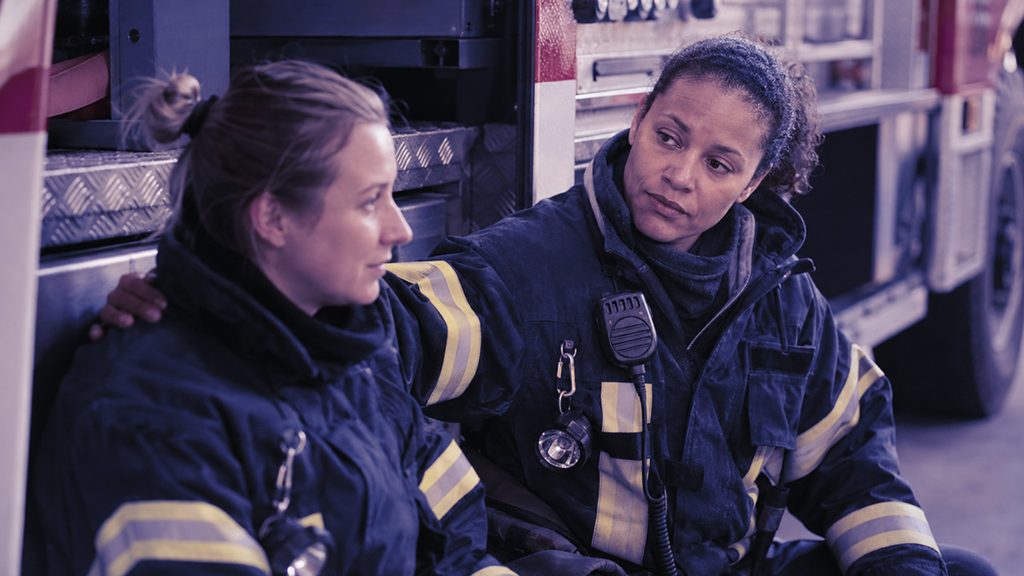
As a paramedic, you arrive at what is very likely the worst moment in someone’s life. You do everything you can, then you leave, and often you never know how their story ends. What does carrying that ‘not knowing’ do to a person over decades?
RACHAEL: Nobody tells you that you’re going to be the first person in the middle of these raw, ridiculous, mind-blowing crises, right? I told my therapist one time, “I’m tired of telling people that their loved one’s dead. No one trained me or taught me how to do it. I had no formal… anything.” As the medic, the lieutenant, that was my role. We would show up to these calls, and when the person died, if the family was on scene, I would be the one who would tell the loved ones. Sometimes it was a sweet little old person who died in their sleep. How do you prepare yourself to tell someone their spouse of fifty-something years is gone?
BRANDON: When we show up, they’ll say, “They’re here, they’re here!” And then we watch their hope crumble.
RACHAEL: We shift their entire universe. They woke up thinking their normal life was normal, and now their plans for that day, for the rest of their lives, are completely shattered. And even if my crew didn’t talk to the person specifically, they heard their screams, the yelling, the wailing. They still have to pick up their stuff and walk out of there.
The burden doesn’t come from any one call. It accumulates…
RACHAEL: The job will kill us if we let it. Because if we’re not trained, if we’re not with someone who’s trained, if we never unpack it… We don’t get rid of it. It doesn’t go anywhere. I just learned how to put it in the appropriate bin, on the appropriate shelf, in my mind.
Sometimes you don’t get a reset. It’s call after call, day after day. And at some point, all you want is for it to stop. You want five minutes of not thinking, not feeling, not reliving. I liken it to a fuse panel. Sometimes you have to throw the overall breaker. That’s what people want. That’s what I wanted. I didn’t want to die; I just wanted it to stop, to throw the main breaker. That’s a very common sentiment, whether we talk about it or not.
BRANDON: If we don’t know how to turn it off, we question why it’s there, why the story keeps running, why things keep looping on repeat. And we don’t typically know how to talk about these things, so we don’t. There are very few who say, “Hey, I think I’m going to kill myself today; could you help me out?” Because we think it’s a bizarre personal experience. We think, ‘I shouldn’t be having those thoughts. I don’t want to share that with anybody.’ And so we keep it inside.
What can support first responders in both carrying the burden and putting it down?
RACHAEL: The education piece I appreciate now is having a life outside this job. You need a reason to not throw the breaker. I appreciate my therapist saying, “This is a process; this could take us two years, or it could take us six months; we don’t know.” I’d reply, “We’re in the shit, huh?” And she’d say, “Yeah, but we have to get through the shit if we’re gonna come out the other side.”
BRANDON: This is a new thing I’m working on with Fire to Light. My father-in-law was a platoon chief for forty-two years. He picks weeds. It doesn’t matter where we go, his own garden, the beach, or the park. He’ll be there for twenty minutes hauling weeds out. I said, “What are you doing?” He goes, “I know I’m never going to pick them all. It’s about giving me something to do to take my mind off whatever’s going on.” Forty-two years of experience. Three of his best friends are dying. He’s learned these acts through years and years of therapy. So he can go and do the thing, and then come and be present for his grandkids, his kids, and all of those things.
RACHAEL: We carry this trauma whether we like it or not. What we’ve been really good at lately in the fire service is shifting our focus. Is that the new kid seeing this same shit? It may be my last straw, but it’s his or her first day. We’re recognizing this is how it’s going to go. They’re going to see some stuff that’s going to make them question… ‘What do I do with that? Can I deal with it? Or is it so loud I don’t know how to turn it off?’ The education piece that I appreciate now is “Have a life outside of this job.” You need a reason to not throw the breaker, to not leave all that other stuff. This is a fabulous job. We get a chance to do some amazing things. But we also have to do and see some really terrible things. So, I would tell the guys, “You just had a baby. Congratulations! Make sure you’re figuring out how it’s going to work for you to unpack this. Don’t take it home to your kids and your spouse or to whatever it is you do that allows you to thrive. If you’re screaming at your kids for no good reason, recognize that sign. And if the person you love the most, who loves you and who knows you better than you know yourself, is telling you X, Y, and Z, listen. Because that’s also a sign.”
It’s a lived experience to get here. I certainly wasn’t perfect in my career, and I learned a lot. I don’t know that I did it right. I’m not an expert in any of this stuff. I just know what I know. And if the journey I took can help someone after me make their journey better, that’s really the only thing I’m after. We’re just normal, everyday people put in extraordinary situations. I think we do the best we can; it’s just what we do. We show up and if we don’t know, we figure it out.
The Gifts of Trauma is a weekly podcast that features personal stories of trauma, transformation, healing, and the gifts revealed on the path to authenticity. Listen to the full conversation, and if it resonates, please subscribe, rate, review, and share.
Editor’s Note: This post comprises edited excerpts from The Gifts of Trauma podcast transcript. Selected passages have been carefully woven together to create a cohesive narrative that speaks in the guests’ voices and faithfully represents their perspective. – Rosemary Davies-Janes